Showing posts with label low-power FM (LPFM). Show all posts

Thursday, June 11, 2009

Congress Tunes Into LPFM


We know we’ve talked a lot about Low Power FM (LPFM) stations lately — this is our second post this week — but that’s because there are so many exciting developments in the land of Low Power!

This morning, the House Subcommittee on Communications, Technology and the Internet held a legislative hearing on H.R. 1147, aka the Local Community Radio Act of 2009. FMC arrived at the Hill bright and early to catch all the action.

Chairman Rick Boucher gave a quick overview of the legislation and the importance of LPFM stations: “H.R. 1147, the Local Community Radio Act, introduced by Representatives Doyle and Terry, would provide additional opportunities for low-power FM (LPFM) radio stations. . . LPFM stations, which are community-based nonprofits that operate at 100 watts or less and have a broadcast reach of only a few miles, play a unique role in our media.” Well said, Mr. Chairman. As we love to point out, LPFM stations provide important, community-based alternatives to the automated voice-tracking and homogenized playlists commonly found on the commercial stations. (We've got it all in a fact sheet somewhere. . .)

Members of the subcommittee heard testimony from three different witnesses. First, Peter Doyle of the FCC (not to be confused with Representative Mike Doyle) gave the lowdown on the supposed interference problems touted by powerful commercial lobby group the National Association of Broadcasters (NAB). According to the FCC techies (and the MITRE Corp, an independent systems engineering and research org), any interference with megawatt stations is virtually non-existent. Next up, NAB board member Caroline Beasley gave her testimony opposing the bill. Finally, Cheryl Leanza of United Church of Christ gave a bold statement in support of Low Power Radio to close the hearing.

Beasley’s testimony served to highlight the fact that the NAB is only supportive of localism when it’s politically convenient. In addition to her NAB board role, Beasley is Executive Vice President and CFO of Beasley Broadcasting Group Inc., a mid-sized broadcasting company that's undoubtedly smaller than behemoth station groups like Clear Channel. It seems likely that the NAB picked Beasley to help convince the Subcommittee of its support of local-oriented radio programming. Yet this is exactly what LPFM stations deliver and what the NAB is trying to prevent by aggressively lobbying against LPFM stations in more American towns and cities.

This isn’t the first time corporate radio has sent mixed signals regarding localism. In April, we told you about Clear Channel’s contradicting press releases on localism and, recently, Billboard featured an article about how Clear Channel’s “Premium Choice” initiative emphasizes prerecorded programming over local programming.

The Subcommittee, by and large, did not take the NAB’s bait. Several representatives fired questions at Beasley, some of which she was unable to answer. When Rep. Cliff Stearns asked, “why does the NAB dispute the FCC report [showing that LPFM stations cause no significant interference problems]?”, all Beasley had to say was, “We do. We are on record as disputing the report.” Talk about evasive maneuvers.

Leanza demonstrated the important role LPFM stations play in local communities, while Doyle confirmed that they pose no interference threat to full-power stations. Both of their testimonies were packed with data and examples of the unmet demand for community radio and the immense programming possibilities that would be created by lifting the unnecessary restrictions on LPFM radio. “As I have worked on this issue over the years,” said Leanza, “one of my favorite moments is after I ask someone the question, ‘what would a radio station sound like if you and your community ran it?’ All of a sudden a person’s eyes light up as they start to imagine what they could do. It is a wonderful experience to see the wheels start turning in people’s heads. “

You can read the full testimonies here.

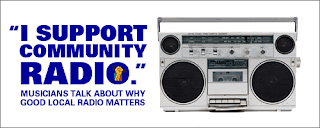
Yesterday, we told you about our brand-spanking-new “I Support Community Radio” campaign, which features established and emerging musicians talking about how local radio has positively impacted their lives — both as artists and listeners. Head here to check out video testimonials from such artists as the Indigo Girls, Saul Williams, David Harrington of Kronos Quartet, Jon Langford of The Mekons and Waco Brothers, Vijay Iyer, Franz Nicolay of The Hold Steady and more. And in their own words, no less!

Now that the hearing is over, Congress will be deciding whether or not to enact the Local Community Radio Act of 2009. Musicians: one way to have your voice heard is to create your own video about what good local radio means to you. E-mail casey@futureofmusic.org to learn how to submit a clip. Oh, and Low Power to the People!

Wednesday, June 10, 2009

"I Support Community Radio" = Artist Video Testimonials


When was the last time you cranked up the volume on your radio because you heard something new, different or local? Chances are it's been a while. But quality local broadcasting doesn't have to be a thing of the past. Together, we can make it an everyday reality.

Radio is still an incredibly important resource for artists, fans and communities. That's why FMC is involved in the fight to expand non-commercial radio as alternatives to homogenized commercial broadcasting. We believe that radio has the power to inspire, inform and entertain while serving up distinct local and regional flavor. And the musicians we've talked to think so, too.

That's why we're psyched to unveil our "I Support Community Radio" campaign, which features videos of artists talking in their own words about why good local radio is so important. We've got some awesome artists on board so far — Saul Williams, the Indigo Girls, Kronos Quartet, Franz Nicolay of The Hold Steady, Girl in a Coma and Jon Langford — with more on the way. (Interested in being a part of this project? Send an e-mail to casey@futureofmusic.org for details on how to submit your own video testimonial.)

One way to put the community back in radio is to lift the unnecessary restrictions on Low Power FM stations in larger American towns and cities. Low Power FM stations are community-based, non-commercial radio broadcasters that operate at 100 watts or less and reach a radius of 3 to 7 miles. LPFM provides a platform for underserved musical genres, minority, religious and linguistic groups and offers a forum for debate about important local issues. (For more info, check out our fact sheet).

The FCC has long supported expanding LPFM, but earlier in the decade, the National Association of Broadcasters (NAB) – who represent commercial radio interests – successfully lobbied Congress to limit LPFM stations to a mere fraction of the number originally proposed by the FCC.

An independent FCC-commissioned study completed in 2003 found no significant interference would be caused by LPFM — we think it's high time for the government to recognize the important role these stations could play in local communities. And it's looking like they finally might — LPFM has strong bipartisan support in Congress, with the Local Community Radio Act (HR 1147 / S 592) serving as the legislative vehicle to get the airwaves primed for low-power.

The Subcommittee on Communications, Technology, and the Internet will hold a legislative hearing on H.R. 1147, the Local Community Radio Act of 2009, H.R. 1133, the Family Telephone Connection Protection Act of 2009, and H.R. 1084, the Commercial Advertisement Loudness Mitigation Act (CALM Act) on Thursday, June 11, 2009, in 2322 Rayburn House Office Building.

Hey, that's tomorrow!

We'll be attending the hearing and will let you know what goes down. In the meantime, check out those artist videos!

Friday, June 5, 2009

Good News for Low Power FM!

Not only is it Friday (woohoo — the weekend!), but here at FMC we just got word that the U.S. Court of Appeals for the DC Circuit issued an important decision in support of Low Power FM radio. (Click here for the full PDF of the ruling.)

Just to catch up, LPFM stations are community-based, non-commercial radio broadcasters that operate at 100 watts or less and reach a radius of 3 to 7 miles. LPFM provides a platform for underserved musical genres, minority, religious and linguistic groups and offers a forum for debate about important local issues. LPFM also has a crucial role to play in disseminating public information for the welfare and safety of local communities. Did we mention that it’s great for local artists who rarely have a shot at getting airplay on their local commercial station?

If LPFM is so great (and it is), why don’t we have more stations like this? Well, earlier in the decade, the National Association of Broadcasters (NAB) – who represent commercial radio interests – successfully lobbied Congress to restrict LPFM stations to smaller communities, claiming that these stations’ tiny signals would cause “oceans of interference” with their own megawatt stations. These restrictions were embodied in the Radio Broadcasting Preservation Act of 2000. The Act limits community organizations’ ability to get LPFM licenses, and makes LPFMs secondary to full power stations. This means they are subject to getting knocked off the air if a full power station moves into the LPFM’s community.

In December 2007, the FCC revised some of it rules and policies in order to protect LPFMs from full-power FM stations that encroach onto the space currently occupied by existing LPFMs. The NAB filed a petition for review of these modifications, claiming they reduce the protections afforded to full power stations and violate the Radio Broadcast Preservation Act.

In a small, but decisive victory for existing LPFM stations, the U.S. Court of Appeals, DC Circuit dismissed the NAB’s petition for review and upheld the FCC’s December 2007 decision to protect LPFM stations. The DC Circuit held that the Radio Broadcast Preservation Act of 2000 did not prevent the FCC from taking measures to protect LPFM stations. Therefore, the FCC’s decision to modify its regulations to protect LPFM stations from encroachment by full-power stations was well within their authority. As the FCC has been a long-time supporter of LPFM, it’s great to have confirmation that the Commission can make decisions about how to protect these small but important broadcasters.

Now for some of that exciting legal detail. We completely understand if you wanna skip this section, but the Court’s ruling has some interesting aspects, so here ya go:

In their petition, the NAB also claimed that part of the FCC’s revised rules would result in the Commission “regulating content.” Here’s the background to their claim: the 2007 FCC modifications established a “presumption” in favor of LPFM stations when a new, full-power FM station and an existing LPFM station begin broadcasting too close to one another in violation of FCC minimum distance requirements (the space between stations that limits signal interference). Essentially, if the existing LPFM station has nowhere to move, but regularly provides “at least eight hours per day of locally originated programming,” the FCC will presume the public interest favors the LPFM station, and will not shut it down. The new, full-power FM station, however, is free to rebut this presumption.

The NAB claims that this presumption allows the FCC to regulate content by favoring local-oriented content over national-oriented content. The DC Circuit held that the FCC presumption in favor of “locally originated programming” is not equivalent to content-based regulation. In the absence of any other evidence from the NAB that the FCC would use the presumption to control content, the court said this issue was “unripe,” which is an odd little legal term that might as well mean “undercooked.”

Overall, the District Court’s decision was a strong one in favor of LPFM. Hopefully it will provide some incentive for Congress to adopt the Local Community Radio Act of 2009, which will be heard by the House Communications, Technology and Internet Subcommittee on June 11. We'll be there to report on the proceedings, so stay tuned. . .

Thursday, May 7, 2009

Nicole Atkins Blogs About LPFM


A handful of posts ago, we told you about how singer-songwriter Nicole Atkins came down to DC for a flurry of appearances on the Hill in support of Low Power FM radio. LPFM is something that an increasing number of artists care about, because it's a great way for a wider variety of music to be heard on the public airwaves. (Guess what? We've got a fact sheet all about it.)

LPFM provides a platform for minority, religious and linguistic groups and offers a forum for debate about important local issues. Then there's the emergency preparedness stuff, which is definitely important. But let's not forget about the music! These mini-stations can really make a difference for artists who otherwise wouldn't get played on the tightly-formatted commercial stations. LPFM stations can give a leg up to those genres of music — bluegrass, zydeco, jazz, etc. — that are identified with certain regions but aren't given much room on by the bigger broadcasters. Which is why we want to see (and hear) more of 'em.

Even singer-songwriters can get in on the action. Which is why Nicole came to town to advocate for more LPFM stations in towns like hers (Asbury Park, New Jersey, to be specific).

But we should probably let Nicole put it her own words. (Maybe she'll get around to putting it in a song, too — we'd love to hear that!) Check out her recent blog post about her adventures on Capitol Hill. And dig those snazzy pics!

Friday, April 24, 2009

LPFM On the Hill Recap


Nicole Atkins on the Hill (More and better pics on the way!)

This just in: Washington DC has been been invaded. . . by Low Power FM supporters! We had you there for a second, right? OK, probably not.

As we previously mentioned, advocates from around the country have come to the Federal City to talk to their representatives about the importance of community radio (specifically LPFM) to their towns and cities. In addition to visits to Congressional offices, supporters went to the FCC and even the White House to tell their stories.

On Thursday, April 23, there was a policy briefing in the Rayburn House Office building. FMC brought Asbury Park, New Jersey singer-songwriter (and Columbia recording artist) Nicole Atkins along to talk about how her town could use an LPFM station. Like, pretty badly.

"Asbury Park has become something like a ghost town over the years, but it's starting to come back," Nicole said. "When I was first starting out, there was a really great local station that was the first to play my music, which gave me confidence as an artist. There’s no longer any stations like that in my town, and LPFM would be a way to give other artists the same chance I had.”

Low Power FM stations are community-based, non-commercial radio broadcasters that operate at 100 watts or less and reach a radius of 3 to 7 miles. LPFM provides a platform for underserved musical genres, minority, religious and linguistic groups and offers a forum for debate about important local issues. LPFM also has a crucial role to play in disseminating public information for the welfare and safety of local communities.

The FCC has wanted more LPFM stations for a long time, but earlier in the decade, the National Association of Broadcasters successfully lobbied Congress to restrict these stations to all but the smallest communities, claiming interference with their own megawatt signals. This is a bit like saying that a flashlight will steal brightness from a floodlight, and an independent FCC-commissioned study completed in 2003 found no significant interference would be caused by LPFM. (Read our fact sheet to learn more about the issue.)

That's why there's a coordinated effort to get a bill passed that would lift the ban on LPFM in more American towns and cities. Groups like FMC, Prometheus Radio Project, the Leadership Conference on Civil Rights, Media Access Project, United Church of Christ, the Media and Democracy Coalition and Free Press are all doing their part to provide important information about the benefits of LPFM — from emergency preparedness and local issues-awareness to art and cultural programming that probably wouldn't be heard on commercial (and even te bigger non-commercial) stations.

Low Power to the people!

Tuesday, April 21, 2009

Nicole Atkins and LPFM supporters on the Hill


Congressional recess is over (or district work period, as the grown-ups call it) and our representatives are back on the Hill, doing those legislative things they do. So it's as good a time as any for a community radio pop-in.

On Thursday, April 23, Low Power FM supporters from around the country will visit the offices of their various representatives to talk about how LPFM benefits local communities. FMC is bringing kickass New Jersey singer-songwriter Nicole Atkins along for the ride, which includes a Policy Briefing on LPFM in room 5456 of the Rayburn House Office building.

In addition to Nicole, the briefing panel includes moderator Parul P. Desai, Vice President of Media Access Project, Liz Humes of WRIR-LP in Richmond, VA, Erubiel Vallardes of KPCN-LP, in Woodburn, OR and Cheryl Leanza of United Church of Christ.

Then there's the visits by advocates to Congressional offices, the FCC and even the White House. If you're among those coming to D.C. for the activities, one bit of advice: wear comfortable shoes, because it's a lot of walking!

Stay tuned for reports on our LPFM adventures (and for more info on this issue, check out FMC's handy fact sheet).

Friday, April 17, 2009

Clear Channel Gets Local. Sort Of. Maybe. Not Really.


Yesterday, Clear Channel sent out two press releases that seemed to contradict each other on some pretty fundamental levels. The first described a "commitment" to a "higher minimum level of service" in the communities in which its stations operate."

There's also a passing bit about "an expanded programming commitment to music from local artists." If you listen to commercial radio, you're probably familiar with stations' graveyard shift local music programs, many of which start at midnight on Sunday. Artists heard on these slots rarely, if ever, make it to regular programming. Does this mean that Clear Channel stations will start slotting local music at other times of day, say, drivetime? Will they also start to spin more indie content? It's tough to tell from this press release.

The second announcement from Clear Channel actually talks about making their programming less local. Yep, it's all about syndicated content — but local stations will be able to choose which syndicated content they want from pre-defined packages. "Local Clear Channel Radio program directors will have total choice and flexibility in choosing the Premium Choice programming elements. They can elect large portions, single pieces, or none of the offered programming. All of the Premium Choice elements were determined in full consultation with the company’s most experienced and trusted programming and operations managers." Lucky them!

Ex radio industry honcho Jerry Del Colisano does a typically good job in describing the cognitive dissonance of these dual releases over at his Inside Music Media blog.

The bait-and-switch that Clear Channel is trying to sell to the public is basically this: we cut back local programming and at the same time announce an empty shell that it touts as increasing local public service programming and outreach. . .

. . .As we said a few weeks back, Clear Channel has a plan in place to make sure there is a warm body on duty at every studio site -- looking ahead to possible FCC objections to turning their local broadcast licenses into a network that has basically nothing to do with the local city of license. Is this what a license has become -- a license to steal local radio stations from the public airwaves?

It's clear that the massive consolidation in station ownership that followed the 1996 Telecommunications Act has been a disaster, both as a business plan and as a means to serve local communities. But Clear Channel's answer to the problem has thus far looked like more consolidation and automation, with a bone or two thrown at localism.

FMC has issued two studies that look at the effects of consolidation on commercial radio: 2002's Radio Deregulation: Has It Served Citizens and Musicians? and 2006's False Premises, False Promises: A Quantitative History of Ownership Consolidation in the Radio Industry. We're also about to release a new report that examines playlist composition on commercial stations to determine whether broadcasters are programming more indie content following the "Rules and Engagement" and Voluntary Agreements that came out of the payola investigations of 2003-2007. (No, we can't tell you the results just yet, but just sit tight — it's on its way!)

One thing we can say: if commercial radio isn't living up to its localism obligations and presents significant barriers to indie artists, then we need non-commercial alternatives. And getting more Low Power FM stations in American towns and cities is an important step.

Next week, LPFM advocates from around the country are coming to Washington, DC to demonstrate their support for local radio. At noon on Thursday, April 23, there will be a Policy Briefing on LPFM on the Hill — room 5456 of the Rayburn House Office building, to be precise.

Thursday’s briefing will feature opening remarks from Representatives Michael Doyle and Lee Terry — co-sponsors of The Local Community Radio Act of 2009 (H.R. 1147), introduced in February 2009.

Immediately following is a panel discussion with LPFM producers and policy advocates who will explore the legislation’s potential impact on emergency preparedness, media ownership and arts and cultural broadcasting. Moderated by Parul P. Desai, Vice President of Media Access Project, the panel features singer-songwriter Nicole Atkins, Liz Humes of WRIR-LP in Richmond, VA, Erubiel Vallardes of KPCN-LP, in Woodburn, OR and Cheryl Leanza of United Church of Christ.

That same day, there will be coordinated visits to Congressional offices and the FCC by community radio supporters of all stripes. Sharing information and having some fun is part of what community is all about.

For more information on Low Power FM, check out our fact sheet. And support community radio!

Monday, March 16, 2009

LPFM Push Still Going Strong!


We told you a few weeks ago that the Local Community Radio Act of 2009 — which would allow more Low Power FM stations in towns, cities and suburbs across the United States — is currently making the rounds in Congress. In the meantime, we wanted to keep you up-to-date on the growing support for LPFM.

For those unfamiliar, LPFM is 100-watt non-commercial radio that can be broadcast at low cost to a small community area. FMC supports LPFM as an alternative to homogenized commercial radio, which has seen shrinking playlists and a loss of local focus over the past couple of decades. LPFM could also make broadcasting a real possibility for schools, labor unions, churches and non-profit groups. On the music side, these "microstations" would create an outlet for developing and local artists to get their music heard. And lets not forget those already-successful acts that for some reason never get any play on the corporate dial — non-commercial and LPFM stations can help bridge that gap.

Last week, FMC Communications Director, Casey Rae-Hunter was interviewed on Pacifica Radio along with Geraldo Reyes from the Coalition of Immokalee Workers and Cory Fischer-Hoffman of the Prometheus Radio Project to discuss how LPFM can help diversify the airwaves and serve local communities. Listen to the segment here.

So where is all of this LPFM stuff headed? Well, with the reintroduction of the Local Community Radio Act and bipartisan support including Representatives Mike Doyle (D-PA) and Lee Terry (R-NE) many think this is the year for LPFM. We’re keeping our fingers crossed, and will let you know how it all plays out. For more info, check out our LPFM fact sheet.

Friday, February 27, 2009

LPFM Gains Momentum!

Earlier this week, we told you about the re-introduction of Low Power FM legislation in the House of Representatives. The Local Community Radio Act of 2009 would bring more LPFM stations to cities, towns and suburbs across the United States — something we all should get behind.

On Wednesday, February 25, members of Congress, public interest advocates and community organizations participated in a national conference call to talk about the bipartisan bill. Joining the discussion was Reps. Mike Doyle (D-PA) and Lee Terry (R-NB), Cory Fischer-Hoffman of Prometheus Radio Project, Shawn Campbell of the Chicago Independent Radio Project, Ben Scott of Free Press and our very own community radio champ Michael Bracy. You can listen to an MP3 of the conversation here.

Our friends at Free Press scored another cool point for LPFM this week with a Huffington Post article by Timothy Carr, brilliantly titled "Celine Dion is Stalking You." They also created a page where you can tell your representative why Low Power FM matters to local communities.

Low Power to the People!

Tuesday, February 24, 2009

New LPFM Legislation to be Introduced


It was only a matter of time before the new Congress saw the reintroduction of a pro-Low Power FM bill. If passed, this legislation would create opportunities for hundreds more community radio stations in cities, towns and suburbs across the United States. The House of Representative's new Local Community Radio Act represents a strong step forward towards this goal.

FMC has long advocated for LPFM (and non-commercial, community radio in general) as an alternative to the homogenized playlists often heard on hyper-consolidated corporate radio. LPFM in more areas would be a tremendous boon to local and independent artists who typically find themselves shut out from area commercial stations. We figure that if more people had the chance to hear the talent in their own backyards, it might even have a positive effect on local economies.

But LPFM isn't just good for musicians — new low-power licenses would make radio station ownership possible for schools, churches, labor unions, local governments, emergency providers and other nonprofit groups, who could use the public airwaves to directly communicate with their local community.

Tomorrow (February 25), members of Congress, public interest advocates and community organizations will hold a national conference call to discuss the reintroduction of the bipartisan Local Community Radio Act. The sponsors of this legislation, Reps. Mike Doyle (D-Pa.) and Lee Terry (R-Neb.) will join the call to explain the details of this bill. Here's the details:

WHAT: National Conference Call on Community Radio Legislation
WHEN: Wednesday, February 25 12 p.m. ET
WHO:
Rep. Mike Doyle
Rep. Lee Terry
Cory Fischer-Hoffman, Prometheus Radio Project
Shawn Campbell, Chicago Independent Radio Project
Michael Bracy, Future of Music Coalition
Ben Scott, Free Press
*** Call this number: (888) 792-8352 Call-in Code- 87422899 ***

The last time LPFM legislation was introduced, it won nearly 100 co-sponsors in the House. The Senate version of the bill, sponsored by Sens. Maria Cantwell (D-Wash.) and John McCain (R-Ariz.) and co-sponsored by then-Senator Barack Obama, unanimously passed out of the Commerce Committee. The Senate is expected to reintroduce a new version of the bill in the near future. We'll keep you updated!

Monday, November 24, 2008

LPFM Event at the Black Cat in D.C.

Attention D.C.-area community radio enthusiasts!

D.C.'s Community Powered Radio Project is hosting a Low Power FM (LPFM) event tonight (Nov 24) at the Black Cat Backstage at 8PM. The evening will feature a screening of the award-winning documentary Pirate Radio USA, followed by a panel discussion that will allow the audience to interact with some of Washington and the nation's leading LPFM advocates.

Come on by and learn about LPFM issues and how you can support the expansion and protection of community radio. Now is a great time to get involved, as the incoming administration and new Congress may hold the keys to take community radio to the next level.

Pirate Radio USA — "a post-objective documentary"
Monday Nov 24th @ 8:00pm
Black Cat Backstage (1811 14th St NW DC)
$5 Admission

Followed by a panel discussion with LPFM advocates:
* Andy Gunn, Technical and Training Organizer, Prometheus Radio Project
* Casey Rae-Hunter, Communications Director, Future of Music Coalition
* Jared Ball, Assistant Professor of Communications Studies at Morgan State University and Creator of "FreeMix Radio: The People's Mixtape"
* Ryme Katkhouda, Founder, People's MEDIA Café and Co-founder, DC Radio Coop

Thursday, November 20, 2008

(Low) Powering Up!

If you're a regular reader of this here blog, you'll know FMC are huge supporters of Low-Power FM. But maybe you just tuned in, as they say in radioland. If so, here's a quick overview.

LPFM stations are community-based, non-commercial radio stations that operate at 100 watts or less and reach a radius of 3 to 7 miles. So they're not designed to pump out the latest hit to the masses. What they are perfect for, however, is giving people in local communities access to the airwaves. LPFM can benefit typically underserved minorities, church groups, niche and local music enthusiasts and more. As commercial radio becomes increasingly homogenized, these smaller stations (which peacefully coexist on unused portions of the radio spectrum) can provide a haven for specialized, community-oriented programming. The FCC thinks so too, which is why they voted in 2000 to issue Low-Power FM radio licenses. Today, there are more than 800 such stations on the air.

So we're cool — all the communities that want LPFM can have it, right? Not exactly.

The FCC was prepared to grant licenses to stations in more urban areas, but there was pushback from the commercial stations (largely represented by the National Association of Broadcasters). This well-connected crew told Congress that those wee-signal LPFMs would cause "oceans of interference" with their own megawatt stations. This made some on the Hill nervous, and so LPFM was barred from larger towns and cities.

Having eliminated (at least temporarily) some 75 percent of possible LPFM licensees, Congress told the FCC to conduct a study to determine if there was any truth to the NAB's claim of potential interference. The Commission "commissioned" the MITRE Corporation (the non-profit org responsible for automated air traffic control and the internet) to conduct a study, which was completed in 2003.

Guess what? The MITRE Corp. found that LPFM stations caused no significant interference problems and recommended lifting the caps imposed by Congress. Since then, a bevy of radio enthusiasts, community groups, artists and musicians have worked together to push for LPFM in more U.S. towns and cities. This broad-based movement has been effective in getting the FCC to revisit its rules regarding LPFM, and, in 2007, two pieces of legislation were introduced in Congress. (The Senate has passed its bill in committee.)

With bi-partisan support and clear public enthusiasm, we think that allowing more LPFM stations is a no-brainer. Of course, the when's and how's aren't quite as clear. We'll keep talking up LPFM because we think it's good for radio, local communities and musicians. You should talk it up, too. Check out our LPFM fact sheet to find out how.

Thursday, July 10, 2008

Low-Power Rangers!


Today, a slew of organizations — including FMC and several other members of the Media and Democracy Coalition — sent a letter to US Congressional Representatives requesting that they co-sponsor H.R. 2802, the bipartisan Local Community Radio Act of 2007. (In this case, a "slew" equals 38.)

Low-Power stations, which operate at 100 watts or less and have a radius of approximately 3 to 5 miles, are more important than ever. The letter hits the nail squarely on the head, stating, "As more media outlets become concentrated into the hands of a few select corporations, LPFMs provide our towns and neighborhoods with a diversity of viewpoints, perspectives, voices, as well as music, arts, and culture often lacking from the commercial dial."

FMC has long supported the expansion of LPFM stations into more areas, which would give communities a chance to experience free, over-the-air broadcasting that truly serves their interests. Check out our Low-Power FM fact sheet for more info.

Monday, October 29, 2007

More Power to Low-Power!


Tomorrow is a big day for supporters of community radio. The Senate Commerce Committee is voting on removing the caps on low-power FM stations in urban markets, something that's long overdue. But, as expected, the big broadcasters aren't happy about it.

In 2000, the FCC voted to issue low-power FM licenses, which many hoped would go a small way towards making up for the loss of diversity and localism that occurred with the passing of the 1996 Federal Communications Act.

The National Association of Broadcasters didn't see it that way. They campaigned hard against LPFM, claiming that the influx of new stations would cause "oceans of interference "on their own megawatt channels. Comprehensive studies have shown this to be patently untrue, but Big Radio still managed to score a ban on 100-watt broadcasting in urban areas through the innocuously-named "Radio Broadcasting Preservation Act," which was passed by Congress in December 2000.

Now LPFM is back on the table. What can you do? Well, if you hurry, you can contact your Senator and tell them how important community radio is to schools, community and religious organizations, nonprofits and music lovers. Call the Capitol Switchboard at 202-224-3121 or visit visit www.congress.org to get your Senator's info. Also, our associates at FreePress.org have made it incredibly simple to send a letter expressing your support for low-power radio.

For more information on LPFM, check out this handy FMC factsheet.


Wednesday, October 17, 2007

Speak up for more low-power radio


We've already told you about our excitement over the radio stations that nonprofits around the country are applying for this week. But there's another campaign afoot to get new voices on the airwaves - and it needs your help.

You might know about the noncommercial, low-power FM stations that air music and cover community news and public affairs, providing unique local services all over the country. (Check out our fact sheet for details.) But opportunities to get these stations on the air are limited. Federal restrictions now in place require LPFMs to give their full-power neighbors a wide berth, keeping community broadcasters off the air in bigger cities.

Yet an independent study has proven these restrictions unnecessary, and legislation now pending in Congress would loosen these limitations and give more low-power broadcasters access to the airwaves. FMC joined musicians, community broadcasters and public interest advocates in June to publicize this effort.

By calling or writing your representatives in Congress, you can show your support for this important legislation. Free Press and the Consumers Union make it easy with forms here and here. And the Prometheus Radio Project offers lots more information, including instructions about reaching your reps by phone. Don't delay - speak up for locally owned and operated radio!

Photo by Jacques-Jean Tiziou / www.jjtiziou.net

Friday, September 7, 2007

This Week In News: Friday, September 7, 2007

Music Industry

The Music Man
An interview with Rick Rubin, co-head of Columbia Records, sheds light on the music industry and how it can be saved amidst the impacts of file-sharing.
by Lynn Hirschberg, The New York Times, September 2, 2007

Apple Supersizes iPod Capacities, Labels Unenthusiastic
Apple now offers its popular iPod with 80GB and 160GB capacities. However, labels worry that those who do fill their 160GB devices to capacity will be filling it with pirated video and audio rather than purchased content.
by Paul Reskinoff, DigitalMusicNews, September 5, 2007

An Update On EMI's Digital Album Share
EMI's increased digital album market sales are believed to credited to their movement away from DRM-protected tracks.
Coolfer, September 5, 2007

BMI Posts Record Revenue Totals, Artist Payouts
Although the CD sales are slumping, BMI recorded an 8% increase in revenue totals from last year. The increase is credited to revenue from cable and satellite radio, as well as other new media outlets.
by Paul Reskinoff, DigitalMusicNews, September 4, 2007

RIP for the CD?
Fong offers another interesting look at the demise of the CD while examining areas where it still succeeds.
by Jennifer Fong, The Edmonton Journal, September 3, 2007

Indie Labels Venture Into Venue Business
In an effort to expand business, indie labels such as Omaha's famous Saddle Creek have begun to open venues. Their access to artists and their opinions has so far lent to the venue's success.
by Mitchell Peters, Billboard.biz, September 4, 2007

Radio

Thousands Support Local Radio
Over 10,000 responded in favor of the FCC's proposal to limit the amount of licenses one group can obtain in the upcoming FCC opportunity for non-profits to build full-power FM radio stations.
Prometheus Radio Project, September 5, 2007

Airing Their Differences About Pay for Play
With Internet and satellite radio stations paying artist royalties, musicians are starting to wonder why terrestrial radio stations aren't asked to the same. Broadcasters argue that artists benefit from the publicity of terrestrial radio but in the face of lagging CD sales, the music industry is pushing for royalties.
by Marc Fisher, Washington Post, September 2, 2007

Momentum Builds for Low Power FM Radio
Support is growing for the bipartisan Local Community Radio Act, which would create thousands more LPFM stations to offer local news and programming.
Free Press, August 24, 2007

New Devices Bring HD Radio to Itunes
Two new devices which combine HD radio and Itunes "tagging" are helping to promote HD radio as a whole. "Tagging" allows HD radio listeners to tag songs they like and then purchase them later from the Itunes store.
by Susan Visakowitz, Billboard.biz, September 6, 2007

Thursday, August 30, 2007

WPFW: Why Community Radio Matters


Jenny just returned from Piety Street Recording studios in New Orleans where Damian & Tim from OK GO, Bonerama and Al "Carnival Time" Johnson were collaborating on a forthcoming benefit record to support Sweet Home New Orleans.

While there she listened obsessively to WWOZ the spectacular community radio station that features a lot of local New Orleans music. Just this morning she was sent this link to a mini movie about DC's own spectacular community radio station WPFW. It was produced by Jessica Duda who is also working on a Net Neutrality documentary. It gives you a clear picture of why it's so important to expand community and low power radio.

Friday, July 6, 2007

OK GO on Capitol Hill

With more than 20 million views of their treadmill video, OK GO has the kind of exposure and constituency that politicians dream of. OK GO and the Future of Music Coalition took that political muscle to Capitol Hill last Thursday to talk about two very important issues: low power radio and net neutrality.


The boys, who looked natty in vintage suits, also got to fill in the lawmakers on their recent trip to New Orleans, along with FMC, to raise money for artists displaced by Hurricane Katrina. Here are some photos:

Friday, June 22, 2007

This Week in News: Friday, June 22, 2007


Radio

Doyle Bill Would Encourage New Low-Power FM Stations
U.S. Rep. Mike Doyle introduced a bill on June 21 that could prompt hundreds of new low-power FM radio stations to sprout up around the country, including the Pittsburgh region. The bill would relax a restraint that prevents new stations from securing spots close to existing full-power commercial stations on the radio dial.
by Jerome L. Sherman, Pittsburgh Post-Gazette

New Measures Could Bring Influx of New Noncommercial Radio to the Airwaves
Hannah Sassaman of the Prometheus Radio Project joins us to talk about a series of developments that could result in the creation of hundreds – if not thousands – of new noncommercial radio stations. Legislation has been introduced that would allow the FCC to grant more licenses to low-power FM stations.
Democracy Now!, June 22, 2007

Clear Channel to Indy Musicians: Swap Exposure for Royalties
A settlement between the Federal Communications Commission and major broadcasters requires them to commit a certain amount of airtime to independent musicians. But Clear Channel Communications, one of the four broadcasters that settled, is asking independent musicians to agree to forgo royalties in exchange for the exposure.
by Neda Ulaby, National Public Radio, June 21, 2007

Conservatives Dominate the Airwaves
According to a new report that indicates conservatives dominate talk radio, "92 percent of the political talk radio programming on the stations owned by the top five commercial station owners was conservative, and only 9 percent was progressive."
Center for American Progress, June 21, 2007

Webcasting

Web Broadcasters Plan Protests Over Royalties
Live 365 Inc., Pandora Media Inc., and Yahoo Inc.'s Yahoo Music are going silent on June 26 in a "Day of Silence" to protest the increase the new royalty rates set to go into effect on July 15.
by Sarah McBride, Wall Street Journal, June 21, 2007

Day of Silence Nears, AOL, Clear Channel Remain Aloof
A broadening number of internet-based radio stations are now joining the June 26 Day of Silence, part of a larger protest against imminent royalty increases. The group now includes heavyweights like Yahoo, RealNetworks and MTV Networks, though titans AOL and Clear Channel Radio remain aloof.
Digital Music News, June 21, 2007

Webcasting Rate Hearing in Congress, Next Thursday
On Thursday, June 28, the House Small Business Committee will hold a hearing entitled 'Assessing the Impact of the Copyright Royalty Board Decision to Increase Royalty Rates on Recording Artists and Webcasters.' The hearing will examine the decision to raise rates, the impact it will have on Internet Radio, and the challenges of providing fair compensation for copyright owners while maintaining a business environment that allow small Webcasters to thrive.
Radio and Internet Newsletter, June 21, 2007


Net Neutrality

An Explosion of Comment on Net Neutrality
In the three-month period for public comment on Net Neutrality, over 11,000 people filed comments to the FCC, including private citizens, lobbyists, and companies like Google. Most of the comments favored the preservation of an open internet
ZDNet, June 21, 2007

FCC Commissioner Takes Brave Stand for Open Access
FCC Commissioner Jonathan Adelstein announced his support for open access internet and its importance in fostering competition.
by Timothy Carr, Huffington Post, June 21, 2007

Google Files Net Neutrality Pleas with FCC
Google filed 47 pages of comments on Net Neutrality last Friday. In the comments, Google outlines a list of what the company believes is okay and not okay for broadband providers to do in controlling the internet.
by Jason Lee Miller, WebProNews, June 19, 2007

2008 Candidates Split Over 'Net Neutrality'
Net Neutrality is a hot issue in the 2008 Presidential Election. Find out what the candidates are saying about it and if they're taking action in this article from NewsMax.
by John Mercurio, NewsMax.com, June 19, 2007

Music Industry

V2 Inks With Peter Gabriel's We7 for DRM Free Ad Supported Downloads
The download service We7 is offering free (and DRM-free) downloads. "The advertising attached to the music will ensure that artists receive royalties and consumers get and can share DRM-free music. After a period of time users will have the choice to have the track ad free and there's an option to buy the track ad free at a normal price."
Hypebot, June 20, 2007

The Record Industry's Decline
Rolling Stone examines the fall of the record industry in this two-part article.
by Brian Hiatt and Evan Serpick, Rolling Stone, June 19, 2007; Part 1 and Part 2

Politics and Hip-Hop Are Doing a Mash-Up
Newsweek’s Steven Levy discusses the legality of creating mash-ups with Congressman Mike Doyle and mash-up artist Greg Gillis (Girl Talk).
by Steven Levy, Newsweek, June 25, 2007 issue

Can Rap Regain Its Crown?
Although the entire record industry has been suffering as of late, sales of rap records have suffered more. Possible factors for rap's decline include the emphasis of selling singles over albums and the overall decrease of quality in recent rap.
by Steve Jones, USA Today, June 15, 2007

Copyright Law

WIPO Broadcasting Treaty Talks Break Down
At issue at this meeting was a proposal to increase the rights of broadcasters and cablecasters over their transmissions in order to prevent signal theft. The discussion stalled progressively as objections and alternatives to language in the chair’s unofficial draft treaty proposal piled up, sources said. Read more about the disagreements here:
IP Watch, June 22, 2007

Other

Required Reading: the Next 10 Years
Intellectual property and copyright law pioneer Larry Lessig announced that he is stepping back from his role in the copyright law community to focus on "corruption" related issues.
by Larry Lessig, Lessig Blog, June 19, 2007