Wednesday, June 10, 2009

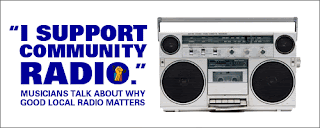
"I Support Community Radio" = Artist Video Testimonials


When was the last time you cranked up the volume on your radio because you heard something new, different or local? Chances are it's been a while. But quality local broadcasting doesn't have to be a thing of the past. Together, we can make it an everyday reality.

Radio is still an incredibly important resource for artists, fans and communities. That's why FMC is involved in the fight to expand non-commercial radio as alternatives to homogenized commercial broadcasting. We believe that radio has the power to inspire, inform and entertain while serving up distinct local and regional flavor. And the musicians we've talked to think so, too.

That's why we're psyched to unveil our "I Support Community Radio" campaign, which features videos of artists talking in their own words about why good local radio is so important. We've got some awesome artists on board so far — Saul Williams, the Indigo Girls, Kronos Quartet, Franz Nicolay of The Hold Steady, Girl in a Coma and Jon Langford — with more on the way. (Interested in being a part of this project? Send an e-mail to casey@futureofmusic.org for details on how to submit your own video testimonial.)

One way to put the community back in radio is to lift the unnecessary restrictions on Low Power FM stations in larger American towns and cities. Low Power FM stations are community-based, non-commercial radio broadcasters that operate at 100 watts or less and reach a radius of 3 to 7 miles. LPFM provides a platform for underserved musical genres, minority, religious and linguistic groups and offers a forum for debate about important local issues. (For more info, check out our fact sheet).

The FCC has long supported expanding LPFM, but earlier in the decade, the National Association of Broadcasters (NAB) – who represent commercial radio interests – successfully lobbied Congress to limit LPFM stations to a mere fraction of the number originally proposed by the FCC.

An independent FCC-commissioned study completed in 2003 found no significant interference would be caused by LPFM — we think it's high time for the government to recognize the important role these stations could play in local communities. And it's looking like they finally might — LPFM has strong bipartisan support in Congress, with the Local Community Radio Act (HR 1147 / S 592) serving as the legislative vehicle to get the airwaves primed for low-power.

The Subcommittee on Communications, Technology, and the Internet will hold a legislative hearing on H.R. 1147, the Local Community Radio Act of 2009, H.R. 1133, the Family Telephone Connection Protection Act of 2009, and H.R. 1084, the Commercial Advertisement Loudness Mitigation Act (CALM Act) on Thursday, June 11, 2009, in 2322 Rayburn House Office Building.

Hey, that's tomorrow!

We'll be attending the hearing and will let you know what goes down. In the meantime, check out those artist videos!

Tuesday, June 9, 2009

SXSW 2010 Wants To Hear Your Voice!


If you caught the music panels at SXSW 2009, you probably witnessed some pretty interesting stuff (especially those FMC speakers). But maybe there was a topic or issue you think was overlooked. Well, now you can have a hand in next year’s programming! SXSW recently launched its 2010 “Panel Picker” interface — an online system that allows the SXSW community to weigh in on what they’d like to see disussed at the 2010 event in Austin, TX.

SXSW is encouraging anyone with an awesome idea for a panel or presentation for either the music, interactive or film events to submit their proposals (a maximum of two per person) online for consideration from now until July 10.

The voting process begins on August 10, and lets you, the web community (along with the SXSW staff and advisory board) to voice your opinions as to what will be presented at SXSW ‘10. If you don’t have specific suggestions, you can still be a part of the selection committee, by browsing through a list of options and voting for what you’d like to see (public voting will count for 30% of the decision making process). Click here for more information on how to plug in.

This is the first year that SXSW has expanded its Panel Picker program to the music community, so we’re guessing that next year’s discussions could get even more interesting. And of course, we’ll keep you posted on any FMC action at SXSW. . .


Monday, June 8, 2009

FMC seeks Website Project Manager/Graphic Designer


Future of Music Coalition seeks a freelance, part-time graphic designer and website project manager for our conference in October 4-6, 2009

Responsibilities include:

Website- building/troubleshooting new website functionality using drupal- maintaining content on new event website using web-based CMS

Graphic Design - designing handbills, posters, banners, signs, event program and other necessary print pieces for the event- resizing existing web graphics on an as-needed basis

QUALIFICATIONS - Knowledge of QuarkExpress/InDesign, Illustrator, Photoshop- Drupal coding experience necessary- Good design eye (font or color doesn't match, that's not consistent with the other postcard, we forgot to update the time/prices, etc)- Project management experience, good with follow through/follow up- Creative problem solver/troubleshooter- Flexible, organized, detail-oriented individual who can work independently- Skilled at managing people and expectations- Telecommuting is totally cool- We're a mac office FYI

COMPENSATION - Compensation will be commensurate with experience.

TIMELINE- Event is Oct 4-6, 2009. You will need to be available June-October on as needed basis. The bulk of the work would probably happen in June/early July and September.

TO APPLYPlease send cover letter, resume and links to work samples to jobs@futureofmusic.org. Position is open until filled.

Friday, June 5, 2009

Good News for Low Power FM!

Not only is it Friday (woohoo — the weekend!), but here at FMC we just got word that the U.S. Court of Appeals for the DC Circuit issued an important decision in support of Low Power FM radio. (Click here for the full PDF of the ruling.)

Just to catch up, LPFM stations are community-based, non-commercial radio broadcasters that operate at 100 watts or less and reach a radius of 3 to 7 miles. LPFM provides a platform for underserved musical genres, minority, religious and linguistic groups and offers a forum for debate about important local issues. LPFM also has a crucial role to play in disseminating public information for the welfare and safety of local communities. Did we mention that it’s great for local artists who rarely have a shot at getting airplay on their local commercial station?

If LPFM is so great (and it is), why don’t we have more stations like this? Well, earlier in the decade, the National Association of Broadcasters (NAB) – who represent commercial radio interests – successfully lobbied Congress to restrict LPFM stations to smaller communities, claiming that these stations’ tiny signals would cause “oceans of interference” with their own megawatt stations. These restrictions were embodied in the Radio Broadcasting Preservation Act of 2000. The Act limits community organizations’ ability to get LPFM licenses, and makes LPFMs secondary to full power stations. This means they are subject to getting knocked off the air if a full power station moves into the LPFM’s community.

In December 2007, the FCC revised some of it rules and policies in order to protect LPFMs from full-power FM stations that encroach onto the space currently occupied by existing LPFMs. The NAB filed a petition for review of these modifications, claiming they reduce the protections afforded to full power stations and violate the Radio Broadcast Preservation Act.

In a small, but decisive victory for existing LPFM stations, the U.S. Court of Appeals, DC Circuit dismissed the NAB’s petition for review and upheld the FCC’s December 2007 decision to protect LPFM stations. The DC Circuit held that the Radio Broadcast Preservation Act of 2000 did not prevent the FCC from taking measures to protect LPFM stations. Therefore, the FCC’s decision to modify its regulations to protect LPFM stations from encroachment by full-power stations was well within their authority. As the FCC has been a long-time supporter of LPFM, it’s great to have confirmation that the Commission can make decisions about how to protect these small but important broadcasters.

Now for some of that exciting legal detail. We completely understand if you wanna skip this section, but the Court’s ruling has some interesting aspects, so here ya go:

In their petition, the NAB also claimed that part of the FCC’s revised rules would result in the Commission “regulating content.” Here’s the background to their claim: the 2007 FCC modifications established a “presumption” in favor of LPFM stations when a new, full-power FM station and an existing LPFM station begin broadcasting too close to one another in violation of FCC minimum distance requirements (the space between stations that limits signal interference). Essentially, if the existing LPFM station has nowhere to move, but regularly provides “at least eight hours per day of locally originated programming,” the FCC will presume the public interest favors the LPFM station, and will not shut it down. The new, full-power FM station, however, is free to rebut this presumption.

The NAB claims that this presumption allows the FCC to regulate content by favoring local-oriented content over national-oriented content. The DC Circuit held that the FCC presumption in favor of “locally originated programming” is not equivalent to content-based regulation. In the absence of any other evidence from the NAB that the FCC would use the presumption to control content, the court said this issue was “unripe,” which is an odd little legal term that might as well mean “undercooked.”

Overall, the District Court’s decision was a strong one in favor of LPFM. Hopefully it will provide some incentive for Congress to adopt the Local Community Radio Act of 2009, which will be heard by the House Communications, Technology and Internet Subcommittee on June 11. We'll be there to report on the proceedings, so stay tuned. . .

Thursday, June 4, 2009

Chart Attack: Who’s “Indie” When it Comes to Sales?

Digital Music News recently ran an article called “The Gray Art of Counting Indie Sales,” which underlined the confusion of tallying purchases of downloads or CDs based on the music’s “independent” classification. According to the American Association of Independent Music (A2IM), 32 percent of album sales in 2008 came from independent artists, but Nielsen Soundscan puts that number at 12.8 percent. Part of the difficulty in differentiating between an indie and a major the fact that many indie labels enter deals with distribution companies owned by the majors, such as ADA (95% owned by Warner) or Fontana (owned by Universal). As a result, major labels have a tendency “count the sales of their distributed partners, while indies like to downplay those partnerships,” according to DMN publisher Paul Resnikoff.

According to the American Association of Independent Music (A2IM), everything is tallied according to IP ownership — in other words, who owns the masters. "What makes a label an “indie'” is that its master recordings are not owned by one of the major labels," the group stated.

A2IM president Rich Bengloff tipped Digital Music News to that distinction earlier this year. "I think if you asked the man on the street they would go with the ownership criteria because it's permanent," Bengloff said.

FMC has had its own experience with trying to figure out what constitutes an indie or a major label. Over the last year, FMC has conducted research on radio playlists, released last month in the report “Same Old Song.” Since the research was designed to measure the difference in “airplay share” for songs released by major labels versus non-major labels, the backbone of the work was coding all of the labels that received any airplay between 2005 and 2008. When we extracted that list, there were over 6,000 unique record labels that received some airplay.

We ended up having 5 different codes:

• Major: the four majors and any of their many-owned subsidiaries and imprints

• Indie: Following A2IM’s lead, we considered an indie label as one independently owned/that controls its own masters and seems to be responsible for its own radio promotion. Even if the indie label had a distribution deal, we classified them as “indies” since distro deals usually focus on getting songs into retail as opposed to getting airplay on radio.

• Disney: including its imprints Lyric Street, Fearless and Hollywood Records. After completing some early data analysis we discovered it was important to give Disney its own code since, in some formats, this one label or its subsidiaries was garnering 2-3% of total airplay. In essence, Disney has the strength of a major label, but was not part of the payola proceedings and thus needed its own category to isolate its level of influence.

• Legacy: A small set of labels or well-known artists for which their relationships to the major labels has either changed over time, or for which a major label association with radio is likely, but cannot be confirmed. Example: recent releases by The Eagles, Jimmy Buffett, Cheap Trick or Motley Crue: artists who are now putting out their own music, but who have a well-documented history of significant radio airplay while on a major label in the past. There are also some current labels in this pool, such as Tooth and Nail, that started as an indie in the 1990s, but has allegedly created a number of upstreaming deals with major labels. This is also where we put companies like Mountain Dew’s Green Label Sound, which has been releasing singles to promote the soft drink. Clearly, this is a company with a significant promotional budget, but it’s not a major label. Without additional information it was difficult to categorize them as an indie or a major.

• No label/TBD: in the cases where there was insufficient data

Even with these five categories, we had to make many judgment calls. There were cases where a label’s relationship to various major labels had changed over the years. For example, Roadrunner started as an independent but as of January 2007 is now 74 percent owned by Warner Brothers. There are other labels that have a documented upstreaming deal with the majors – such as Fall Out Boy’s label Decaydance, which has a relationship with Island – where the independent label finds a band, puts out their first record and then the major label partner can come in and sign them to a bigger deal. On the charts, if the song had a listing Decayadance, we’d code it as an indie. If it said Decaydance/Island, we classified it as a major. In cases where we could not determine with certainty, we erred on the side of independence. Needless to say, defining “indie market share” is an inexact science, and an ever-evolving landscape.

But what about unaffiliated artists who aren’t on a label – indie or otherwise? We’ve talked recently about services like TuneCore, CD Baby and ReverbNation, which, for a nominal fee, get unsigned artists “stocked” at digital retailers like iTunes, eMusic, Amazon MP3, Rhapsody, Napster and so forth. If an unaffiliated act starts “moving serious units,” to use Music Industry 1.0 lingo, how do they demonstrate this success to the wider world? For this, you probably need some kind of ranking system that the industry (and fans) perceive as legitimate.

TuneCore currently has a chart in Billboard showcasing the 25 top-selling artists who use their service. (This chart displays two types of data: top selling full albums by total earnings for the period and top selling individual songs by earnings for the period.) Appearing in Billboard would do more than make your mom proud — it actually means something to the industry. But since established mainstream artists also use TuneCore, the top spots are often already filled. For instance, Jay Z, David Byrne, Joan Jett and t.A.T.u are all currently featured on TuneCore’s March 2009 album list (as reported in May 2009). That’s some stiff competition. (Click here for a look at the most recent charts.)

Digital distributor/marketing tool ReverbNation also has charts to show which of its artists are selling the most. But unlike TuneCore’s Billboard chart, which lumps all musicians irrespective of genre into a single top 25 listing, ReverbNation breaks its lists down by not only style of music, but also by location. You can find the top selling albums/songs from musicians from US or even the world,, including your own backyard. (Similarly, TuneCore’s iPhone app uses a geolocator that tells you the 25 best selling TuneCore songs based on your exact zip code.)

Keep in mind that all of this is based on downloads. While digital sales might currently be a better indicator of “success” than MySpace plays, there isn’t (to our knowledge) a chart that measures on-demand listens where you don’t keep the digital file. As people grow more accustomed to “accessing” music as opposed to owning it, accounting for online plays could become increasingly important.

As more artists go direct to fans and label roles evolve, all of this gets a bit fuzzier. Will everyone eventually be wading in the same digital pool? Do standard chart measurements even apply in a world of limited-edition physical items, on-demand streams and (potentially) legal filesharing?

For a lot of musicians, having people at your shows and moving some merch is achievement enough. But we’re curious: what do you think counts as success with recorded music? Feel free to let us know in the comments.
Tuesday, June 2, 2009

This Week In News


Sony Agrees to Provide Its Older Songs to eMusic
In another example of struggling major music labels and Internet services finding common ground, Sony Music Entertainment has agreed to make its back catalog of songs available on eMusic, one of the largest music retailers on the Web. Brad Stone, The New York Times


Live Nation to Rollout ‘No Service Fee’ Promotion
Live Nation will eliminate service fees on more than five million lawn tickets and hundreds of concerts for its amphitheaters in a one-day promotion June 3. The 24-hour sales event is being billed as the biggest ticket promotion ever, which would be hard to dispute. "No Service Fee Wednesdays," begins June 3 at 12:01 a.m., offering fans some of the lowest prices of the summer with no ticket service fees on any LiveNation.com-ticketed amphitheater show, and only at LiveNation.com. Ray Waddell, Billboard.Biz


Web Radio Hits the Road
It took a long drive over a holiday weekend -- a setting that should have played to all of radio's traditional strengths-- to show how much trouble commercial FM stations may have in store. The soundtrack for the trip along Interstates 66 and 81 to the Shenandoah Valley town of Woodstock, Va., came not from FM, an XM or Sirius satellite broadcast or such recorded alternatives as CD or iPod. Instead, our musical selection came from an Internet-connected smartphone that streamed Web radio to the nearest speakers through a cheap tape-deck adapter. Rob Pegoraro, The Washington Post


Walmart Shutting Down DRM Download Servers
Walmart.com's music download store went DRM free in February of 2008; and now the retail giant is telling customers that they'll no longer support the DRM laden downloads that they sold them prior to the transition. Hypebot.com


This Just In: Old People Hate New Music
… E Street Band guitarist “Little” Steven Van Zandt is citing the sucktitude of today’s rock ‘n’ roll as the reason the record industry is sinking faster than the Lusitania (“Who are we kidding here? Nobody’s buying records? Because they suck!”). Modern rock’s suckiness, the apparently computer-illiterate Van Zandt claims, can be traced to the fact that this generation’s musicians are eschewing the time-honored tradition of playing cover songs in bars (so’s they can focus on original material, the bastards!) and ignoring the importance of ripping off the popular rockers who came before them. James Greene Jr, Crawdaddy.wolfgangsvault.com


Billboard.biz Q&A: Former RIAA CEO Rosen Talks Napster
When Napster first went live 10 years ago this month, the music industry didn't immediately notice. It wasn't until around September 1999 that the RIAA got wise, and not until December that a lawsuit was filed. Leading the organization at that time was Hilary Rosen, who presided over the case that shut down Napster and all the music industry moves that followed until she resigned in 2003. Anthony Bruno, Billboard.biz

Friday, May 29, 2009

Is "Cloud" Music Becoming a Reality?


Digital Music News ran a short item today about Spotify — a fast-growing free/subscription streaming service that's available overseas but not yet in the US. The article is about a demo of an upcoming app for Google's Android cellphone platform:

An Android mobile app was splashed at the Google I/O conference in San Francisco, a work-in-progress that quickly excited music fans and bloggers alike. As one would expect, the app demo featured on-demand access to a catalog of millions, using available WiFi. But users will also be able to access tracks while disconnected, a feature that eliminates a huge connectivity hurdle.

There's also a YouTube clip of a similar Spotify app for iPhone, which, to the best of our knowledge, has yet to be approved by Apple. If anything could compete with iTunes, it's Spotify, so it will be interesting to see if an iPhone app does indeed roll out with a Spotify US launch (rumored to happen later this year).

Although it's not officially available in the US, Spotify is starting to win converts among American music reporters and pundits. Wired's Eliot Van Buskirk says the service is “like a magical version of iTunes in which you’ve already bought every song in the world," and industry observer Bob Lefsetz has been moved to praise Spotify IN ALL CAPS on more than one occasion.

There are probably several reasons for Spotify's rapid adoption in countries like the UK, where it's been available for a year or so. The graphic interface is straightforward (and very iTunes-like), and, since it employs a robust desktop client, there is practically zero lag (yes, we've tested this.) Spotify also uses the superior Ogg Vorbis format for its streams, which means it actually sounds good. Perhaps most attractive is the fact that the service is free — as long as you don’t mind hearing a solitary audio ad every half-hour or so (there's also a paid version without the ads). This means that artists and sound copyright owners are compensated, which we think is top priority for any new digital music doohickey.

Keep in mind that Spotify is on-demand listening, not "predictive radio" like Pandora (which is also gaining popularity, largely due to mobile applications).

Music-tech analyst Andrew Dubber gives a useful overview of Spotify, which you can read here. Among his favorite features:

. . .every artist, every album and every track has a unique URL that can be sent via email, Twitter, IM, Facebook or any other kind of messaging system - and if the recipient also has Spotify installed, that music will play in exactly the same way it did for the person sending it.

Recently, Andrew made a recommendation via his Twitter feed; if you're a Spotify user, you could click the link and the album he was talking about immediately pops up and starts playing on your end. With the ubiquity of social media, it’s easy to imagine this becoming a powerful, cost-effective and legal way to share music.

Some have complained that Spotify, while rock-solid performance-wise, is lacking some essential features. On the other hand, the Spotify folks have opened their service to outside development, which likely means enhancements are forthcoming. Essentially, approved third-party devices and services would be able to use Spotify’s engine and catalog, which could be particularly fruitful in the mobile space.

There are also concerns that subscription and ad-based models don't pay artists and labels as much per play as downloads of physical sales. But that could change, especially if more people get hooked on listening this way. It could also help curb piracy — why take the chance on viruses and music in crappy bitrates, when you can get better quality tunes for "free" (or at a nominal cost)?

The idea of being able to listen to practically everything you'd ever want to whenever you want to isn't new. But American consumers haven't fully embraced such services, even with Rhapsody, Napster, etc. offering some version of subscription-based access. Will Spotify be the model that makes "the cloud" click? Only time will tell. . .

Wednesday, May 27, 2009

Back From New Orleans!


FMC's Jean Cook and Jon Langford rock New Orleans

Our three-day bacchanal in the Big Easy (a highly productive bacchanal, we might add) has ended, and FMC staff are back in D.C., where we're basking in the warm memories of another successful Artist Activism Camp and "Musicians Bringing Musicians Home" concert. Bet you wish you had been there! Well, maybe you were. . . if so, cheers!

This year's retreat included such talented artists as Wayne Kramer (MC5), Jolie Holland, Jon Langford (Waco Brothers, Mekons), Saul Williams, Scott McCaughey (Young Fresh Fellows, Minus 5, R.E.M.), Laura Veirs, Vijay Iyer, Erin McKeown, Bonerama, Al “Carnival Time” Johnson, Martín Perna (Antibalas, TV On the Radio, Ocote Soul Sounds), Mariam Adam (Imani Winds), Luke Reynolds (Pictures and Sounds) and Paul Sanchez.

These musicians joined organizers FMC and Air Traffic Control in New Orleans to participate in strategy sessions about how to integrate activism and philanthropy into their musical lives and careers. They also took the time to tour local neighborhoods and visit with the city’s notable musicians and community leaders.

Then there was the concert, which was a doozy. The all-star show took place on May 22 at Tipitina’s Uptown and benefited Sweet Home New Orleans — a non-profit organization that provides social services and economic development programs to musicians, Mardi Gras Indians, and other traditional New Orleans artists affected by Katrina.

Check out our Events Coordinator Chhaya Kapadia's Flickr stream for a birdseye view of the action. Rumor has it the great Jon Langford was also prowling around with a flipcam; we'll post that video as soon as we determine its suitability for public consumption.

You should also have a look at Chhaya's post on her own blog about her experiences in New Orleans. She's a true Artist Activism Camp veteran (or "Carnival Timers," as participants call each other), with five retreats and concerts under her belt. Hot damn!

World Copyright Summit Coming to DC


Copyright issues continue to be front-and-center in discussions about creative content in a rapidly-evolving digital environment. And tensions between technology and intellectual property aren't just a U.S. concern — these issues impact entertainment industries and creative economies across the globe, and ultimately shape how music (and other art and media) is created, distributed and accessed.

On June 9 and 10, The World Copyright Summit takes place at the Ronald Reagan Center in Washington, D.C. The event will examine issues impacting creators in the digital age, particularly questions like: what does the future hold? How will creative works be produced, distributed and consumed? How will creators receive reward for their works and what new challenges face users regarding regulation? These are just some of the big-picture issues to be discussed during the two-day Summit. Did we mention that FMC is one of the media partners for WCS? We’ll be at the event and hope to report back on what goes down.

The Summit features key US, European and Asian copyright policy makers as well as world-class creators, industry leaders and over 450 delegates from 53 countries.

Top keynote speakers include Robin Gibb (from a little group called the Bee Gees), US Senate Judiciary Committee Chair Senator Patrick J. Leahy , French Minister of Culture and Communication Christine Albanel , Korean National Assembly Culture and Broadcasting Committee member Dr. Yong-Kyung Lee, National Music Publishers Association President/ CEO David Israelite and Universal Music Publishing Group Chairman/CEO David Renzer — to name a few.

For more information on how to register or to take a look at the full agenda of the event and the list of speakers go to: www.copyrightsummit.com.

Tuesday, May 26, 2009

RIP Jay Bennett


You may have already heard the news about the unfortunate death of multi-instrumentalist/songwriter Jay Bennett, whose talents graced the Wilco records Being There, Summerteeth and the seminal Yankee Hotel Foxtrot. (Bennett's departure from the band is partially documented in director Sam Jones' Wilco documentary I Am Trying to Break Your Heart.)

Post-Wilco, Bennett released several solo albums and produced and/or guest performed on a wide range of releases from other artists. Bennett died on Sunday, May 24, apparently in his sleep. While the actual cause of death is unknown pending autopsy, Bennett had some persistent health problems, and had recently posted on his MySpace blog about his need for emergency hip surgery and the difficulties in scheduling the operation due to his lack of health insurance.

Although we’re not trying to make a connection between Bennett’s death and his lack of health insurance, we can say this continues to be a huge problem for American musicians, and the uninsured in general. It’s not hard to picture how the lack of health insurance could impact any one of us. You might delay seeking professional help for even the most minor medical or dental issues because the cost of care without insurance is so expensive. Minor issues can quickly become major issues, at which point you might be faced with a medical emergency, and no safety net. These conditions can be complicated in the life of a working musician, what with the constant travel, wacky hours, heavy equipment, and a typically unsteady paycheck. This makes health insurance even more important, yet sadly more elusive.

No matter how you slice it, not having health insurance is a recipe for tragedy. This is why we started our Health Insurance Navigation Tool (HINT) program in 2005 to help musicians understand their health insurance options. Now, we know the current system is far from perfect. But we also know that too many artists simply believe that health insurance is too hard to get or too complicated/time consuming to comprehend. We figured that if musicians had access to free, high-quality information about health insurance, it would be a start to addressing a major problem.

After scheduling an appointment on the HINT website (which also contains lots of useful, musician-friendly info), artists get a call from health insurance experts Alex Maiolo or Chris Stephenson, who go over an individual's options on case-by-case, state-by-state basis. Alex and Chris are also musicians who know what it’s like to juggle artistic ambitions with more mundane (but no less important) concerns like making sure you’ve got some kind of coverage in case of an unforeseen health crisis.

Click here to learn more about HINT, health insurance in general and to schedule an appointment with our musician experts.

Our sincere condolences to Jay Bennett’s friends, family and musical associates — he surely will be missed.

Friday, May 22, 2009

TuneCore Scores Spot at Amazon


TuneCore is one of a handful of companies (including CD Baby and ReverbNation) offering digital (and in some instances physical) distribution for the DIY musician. For a relatively small fee, artists using these services can get their tunes in all the major digital music sellers (iTunes, eMusic, Rhapody, etc.) — which means a coffeehouse strummer can be in the same "store" as Beyoncé. Pretty cool, huh? CD Baby will also handle the warehousing and mailorder for your physical discs, and most of these services provide referrals for custom-batch CD manufacturing.

Today, Digital Music News is reporting that TuneCore has made a deal with Amazon to have a special section within Amazon's MP3 store:

The TuneCore-branded environment will live within the broader AmazonMP3 site. Additionally, artists can offer custom-crafted CDs through Amazon partner CreateSpace. The action starts June 1st.

TuneCore already direct-ports downloads into a number of stores, including Amazon, iTunes, among many others. The store-within-a-store builds upon an existing partnership between TuneCore and Amazon, as does the CD-pressing component. The expansion helps TuneCore to expand its value proposition, though it also allows Amazon to breathe some life into its CreateSpace acquisition.

You may be familiar with CreateSpace, which grabs DIY by the long tail (ha!) and lets users self-publish books, music and movies to be stocked and sold through Amazon. We think it's great that more artists are able to use new services to get their creations out there, but if these services continue to take off, there will be that much more stuff to sift through. The question then becomes, what mechanisms can effectively facilitate discovery? Or to put it more simply, how do fans find what they like? Do they just randomly stumble upon it? Does the burden of marketing and promotion rest solely on the creator? How can developing artists most effectively cut through the noise?

In the past, labels handled much of an artist's promotion (PR firms also assist), but the game is changing for any number of reasons — the erosion of the physical CD market, unauthorized filesharing and the uncertainty around new models (like ad-supported and subscription services) — to name a few. For now, this could mean fewer acts get signed to traditional labels, and less money is available for promotion. It could also mean a future where industry entities become "all-in-one" services that provide a combination of marketing and promotion, live booking and tour management, recording and distribution and possibly even rights administration. The so-called "360 degree" deals that are popular with some superstar artists could represent a step in this direction.

But what about all the other artists out there? How will they cultivate and retain audiences? It's one thing to be able to make your stuff available, it's another to get the right people to find it. Magazines and radio have always acted as a kind of filter, but restrictive commercial radio playlists and the financial struggles of print (and online) media combined with the ever-increasing amount of music makes it tough for most artists to attract listeners. Obviously, reaching audiences was a challenge even back when the business of music was dominated by a system of bottlenecks and powerful gatekeepers. But there are new hurdles now that creative content is seemingly ubiquitous.

We're curious to hear your thoughts about the future of DIY and marketing in the digital age — feel free to leave a comment below. . .

Thursday, May 21, 2009

Green Day Bites Back at Wal-Mart


With physical CD sales dwindling, you don't hear as much about how certain records aren't carried by particular retailers due to so-called "objectionable content." But it still happens. Case-in-point: the new album from pop-punk lifers Green Day, whose latest disc, 21st Century Breakdown, cannot be found at Wal-Mart.

Remember, before being overtaken by Apple's iTunes, the brick-and-mortar megastore was the country's largest seller of recorded music. Yet with floor space dedicated to CDs shrinking and online outlets (legal and otherwise) proliferating, does it even matter that the Number One album in America can't be purchased alongside a six-pack of Brawndo and a hunting rifle? Green Day frontman Billie Joe Armstrong thinks so: "Wal-Mart's become the biggest retail outlet in the country, but they won't carry our record because they wanted us to censor it," he said in a recent interview.

Read more in this Comcast.net feature (Comcast actually has a promotion going with Green Day via its On-Demand service — talk about a clash of the corporate titans).

Wal-Mart carries a "clean" version of Eminem's grisly latest, but Armstrong claims "there's nothing dirty about our record." Is this censorship? Tell us what you think in the comments.

Wednesday, May 20, 2009

Artist Activism Camp Kicks Off in New Orleans!


Jon Langford flexes his activist muscles!

FMC staff are on the way to New Orleans for our latest Artist Activism Camp and "Musicians Bringing Musicians Home" concert. There's nothing like a three-day party in the Big Easy to kick off summer!

But it's not all bourbon and gumbo. The May 20-22 retreat — hosted by FMC and Air Traffic Control — is the fifth since the Gulf Coast storms of 2005. Artists from around the country converge on New Orleans to tour affected neighborhoods, visit with the city’s notable musicians and community leaders and participate in strategy sessions about how to integrate activism and philanthropy into their musical lives and careers.

This year's participants include Wayne Kramer (MC5), Jolie Holland, Jon Langford (Waco Brothers, Mekons), Saul Williams, Scott McCaughey (Young Fresh Fellows, Minus 5, R.E.M.), Laura Veirs, Vijay Iyer, Erin McKeown, Bonerama, Al “Carnival Time” Johnson, Martín Perna (Antibalas, TV On the Radio, Ocote Soul Sounds), Mariam Adam (Imani Winds), Luke Reynolds (Pictures and Sounds) and Paul Sanchez. We're excited to see them all!

The "Musicians Bringing Musicians Home" concert takes place at 9 p.m. CST on Friday, May 22 at Tipitina’s Uptown (501 Napoleon Ave) and benefits Sweet Home New Orleans — a non-profit organization that provides social services and economic development programs to musicians, Mardi Gras Indians, and other traditional New Orleans artists affected by Katrina. SHNO is also announcing its first-ever “challenge grant,” in which donations received on May 22 and through the end of the year will be matched, dollar for dollar, up to $250,000. This challenge represents an opportunity to double the impact of contributions to SHNO at a critical juncture in the music community’s recovery. To make a donation to Sweet Home New Orleans, visit www.sweethomeneworleans.org or mail to: 828 Royal Street #833 NOLA 70116.

New Orleans-dwellers will definitely want to mark your calendars for the show. But if you're not a local, you can still can watch via live webcast at Tipitina's — showtime is 10PM CST.

Monday, May 18, 2009

This Week In News


Spotify CEO Talks Portability, Premium Service Growth
Daniel Ek, founder and CEO of music streaming service Spotify, says he wants to build on the early popularity of the ad-supported free model by developing a portable service and attracting users to the premium service. Jen Wilson, Billboard.biz

Analysis: The Orchard Keeps Focus On Long-Term
The latest earnings results from digital distributor the Orchard painted a picture of a company with a focused long-term strategy for an increasingly competitive marketplace. Glenn Peoples, Billboard.biz

The Future of Mobile Music: Will Labels Participate
Phones are frequently viewed as walled-garden alternatives, safe places for controlled media sales. But as phones evolve into handheld supercomputers, is the sordid history of the traditional web doomed to repeat itself? DigitalMusicNews.com

Strapped For Cash, Music Fans Let Go Of CDs
California's Amoeba Records is the largest used-music retailer in the world. The checkout lines often wind deep into the clearance aisles. But not lately. These days, the real action comes from people selling their collections — and using the store as an emergency ATM. April Dembosky, NPR.org

April Album Sales Down 'Only' 9%
U.S album sales were down 9.2% in April 2009 versus April 2008 according to data at Neilson SoundScan. The deficit is a big improvement over the 17.9% deficit in March and the 11.5% deficit in February. Billboard.biz

Pandora: iPhone Driving Revenue Increases
Is the iPhone inadvertently aiding Internet radio? While Pandora’s main source of revenue is in advertising deals, a growing portion of the company’s revenue comes from affiliate downloads that drive sales in the iTunes Store or on Amazon MP3…and the primary mover in that regard these days is the iPhone. AppScout.com

Best Buy Has Plans to Sell Vinyl Records in Stores
Next time you go to your local Best Buy store you may see vinyl records as part of the product mix. While Best Buy does sell vinyl records online, the retailer thinks it may be time to expand accessibility to its vinyl record offerings by devoting space within their physical stores. Robert Silva, About.com

Think Local, Think Indie at New Digital Music Shop
If you’re hoping to survive in the age of file sharing, it pays to be aggressive if you’re a Mom and Pop record shop. So the nationwide Coalition of Independent Record Stores just swallowed its pride and launched a digital music store: Thinkindie.com. Michael Deeds, IdahoStatesMan.com

How The iPod Changed Everything
While pirates bled the music industry, other businesses rode the tide and collected the booty. Former Apple insiders tell Matt Hartley how Steve Jobs did it. The Globe and Mail.com

mSpot Seals More Deals: CBS Radio, Last.fm Latest
Mobile entertainment company mSpot has now sealed deals with both CBS Radio and Last.fm, according to details shared with Digital Music News over the weekend. Both properties are owned by CBS Corp., and are now being integrated more aggressively. DigitalMusicNews.com

Friday, May 15, 2009

Public Performance Right Update

You may have already heard, but there's been some developments regarding the Public Performance Right for terrestrial radio. On May 11-12, a huge array of supporters of the Performance Right focused their attention on Congress. The goal: build up enough support in the House to pass HR 848, that would require broadcasters to compensate performing artists and sound copyright owners (usually the labels) for their work when played (or "performed") over-the-air.

The efforts appear to have had their intended effect: on May 13, the Performance Rights Act passed in the House Judiciary Committee. Last minute-tweaks to the legislation — presented by committee chair John Conyers (D-MI) and largely as a response to pressure from minority broadcasters — included delaying the bill's effective date, reducing the royalty payments due, and insuring that the needs of small, minority, religious and non-music broadcasters are taken into account.

While this is clearly good news for supporters of the Performance Right, there's a way to go before the royalty becomes a reality. The bill still needs to be voted on in the full House, and companion legislation must be passed in the Senate before it goes to President Obama for signature or veto (just like on "Schoolhouse Rock," remember?)

FMC supports a Public Performance Right for a number of reasons, mainly because it would directly compensate performers 45 percent of the royalties owed for the use of their music on over-the-air broadcasts. It's also important to note that the U.S. is one of the only industrialized nations without this right, which means American artists can't collect money owed to them for overseas spins of their music. If you need a refresher check out our Performance Right fact sheet.

And here's all the tagged posts on the issue from this very blog.

Tuesday, May 12, 2009

SanFran MusicTech Summit: Podcast Interview With Brian Zisk


FMC co-founder and Technologies Director Brian Zisk is a fascinating guy to talk to, especially when he's gearing up for one of his SanFran MusicTech Summits, which bring together the best and brightest in the music/technology space along with musicians, media folks, industry representatives and others who contribute to the digital music ecosystem. With the next SFMTS set for Monday, May 18 at the Kabuki Hotel in San Francisco, we figured a podcast interview with Brian was in order.

We asked Brian for a sneak preview of the event, which features panel discussions on "The Future of the Music Industry," "Monetization," "The Studio of the Future." Speakers include FMC’s Jean Cook and Kristin Thomson, Terry McBride of Nettwerk Music Group, Tim Westergren of Pandora, Zahavah Levine of YouTube, Dean Hudson of Sub Pop Records, and FMC advisory board members Josh Wattles of deviantART and Jim Griffin of Choruss/Onehouse/Pho. (To name just a few.)

Once you get chatting with Brian the conversation can end up anywhere, but it's pretty much guaranteed to be interesting. Actually, we can't think of any other podcast interview we've done where both Hannah Montana and Frank Zappa were mentioned. So there you go.

Check out the interview here.

The clock's ticking to reserve your spot at SanFran Music Tech Summit (May 18 is, like, next week), so you should act now. You know Brian will be psyched to see you!

Sunday, May 10, 2009

Twitter Me This


With even members of Congress “tweeting,” it was probably inevitable that the ubiquitous status-updating service Twitter would start being used for things that were just a glimmer in some developer’s eye even a few short few months ago. Besides hipping your “followers” to what you had for breakfast, users are also playing DJ – building playlists on other digital services and “sharing” tunes with the greater Twitterverse.

Wired’s Epicenter blog recently examined some of the most popular Twitter-meets-music applications like blip.fm, twisten.com and song.ly. With most of these music apps, you simply search for a song, it kicks out a shortened URL link to that song that’s being hosted somewhere on the internet and — tweet! — when your followers click on the link, they can hear the song, too. But this article got us thinking: are musicians being compensated for these plays and, if so, how?

Our crack, two-person research department got to work. We dug through various services, using Simple Machines catalog and The Contrarian releases as test balloons. We checked in with a digital music service provider and a content licensor. As far as we can tell, this is what’s going on:

There is no license for this use. . . yet. That’s no surprise, given that the concept of tweeting music is less than 10 months old, and it sometimes takes years for the Copyright Office and other licensing agencies to recognize a use (and even longer for the copyright law to be codified around a new use). Yet this novel use raises some fundamental questions: are these tweets essentially a micro-broadcast that would qualify as a “public performance” and subsequently mean that licenses from ASCAP/BMI/SESAC would be required? If yes, then who is responsible for acquiring and paying for the license? Or does the interactive nature of the tweet mean it should be considered an interactive stream? If it is an interactive stream, that means direct negotiations with labels and publishers would be necessary to acquire permissions and set a rate. But with the music spread across the web — legally or otherwise — and the services themselves acting as “search,” which party would be responsible for getting a license?

Music is being hosted all over the internet. This would be a lot easier if the music was being pulled from a source that already had the licenses in place, something like a Rhapsody or Napster. However, our tests show (and sites’ FAQs indicate) that the songs that pop up in their search boxes – and are subsequently tweeted – are being hosted by random servers all over the internet.

In some cases, musicians may have pre-consented for a use like this. Many times a band or label will identify a couple of songs on each album that are pre-cleared for promotional use, such as made available for a free stream on MySpace, or embedded in a podcast, or posted to an MP3 blog. While it’s possible that the twitter-based search engines are finding this pre-cleared material, which sits on servers all over the place, it’s also highly likely that lots of the songs have not been pre-cleared. In some cases the music may be partially licensed, but even this brings up questions about how revenue is generated – is the site ad-supported, subscription-based, or part of an equity agreement between the rightsholders and the service? What happens when the song becomes a link in Twitter?

Because there is no license, there is no direct revenue for these performances. Without a license in place, all the music being tweeted and re-tweeted are essentially full-length plays for free. There is likely some revenue generated through “Buy MP3” referrals embedded in blip.fm tweets, but the performances themselves are currently unlicensed.

We’re not trying to sound like grumpy old schoolmarms — actually, we get very exited when we see new applications that facilitate the discovery of new music. Still, it’s FMC’s duty to examine new music models to understand whether and how they compensate musicians. Given how quickly music fans have embraced Twitter as a way to hear, share and discover new sounds, those in the music and technology communities should ask a few questions, namely: are these uses sustainable? If so, should they be licensed? Could existing music destinations become the legit backend for socially driven discovery?

Perhaps it is too early to tell whether Twitter + music will flourish, or if it will only last as long as Twitter’s venture capital funding. We’re guessing Twitter is here to stay, which means that folks in both the music and tech worlds will eventually need to work together to ensure the platform’s growth, and to address whether and how musicians are compensated when their music is fleetingly tweeted.

Any Twitter DJ’s out there? What do you think?

Thursday, May 7, 2009

Nicole Atkins Blogs About LPFM


A handful of posts ago, we told you about how singer-songwriter Nicole Atkins came down to DC for a flurry of appearances on the Hill in support of Low Power FM radio. LPFM is something that an increasing number of artists care about, because it's a great way for a wider variety of music to be heard on the public airwaves. (Guess what? We've got a fact sheet all about it.)

LPFM provides a platform for minority, religious and linguistic groups and offers a forum for debate about important local issues. Then there's the emergency preparedness stuff, which is definitely important. But let's not forget about the music! These mini-stations can really make a difference for artists who otherwise wouldn't get played on the tightly-formatted commercial stations. LPFM stations can give a leg up to those genres of music — bluegrass, zydeco, jazz, etc. — that are identified with certain regions but aren't given much room on by the bigger broadcasters. Which is why we want to see (and hear) more of 'em.

Even singer-songwriters can get in on the action. Which is why Nicole came to town to advocate for more LPFM stations in towns like hers (Asbury Park, New Jersey, to be specific).

But we should probably let Nicole put it her own words. (Maybe she'll get around to putting it in a song, too — we'd love to hear that!) Check out her recent blog post about her adventures on Capitol Hill. And dig those snazzy pics!

Tuesday, May 5, 2009

Performance Right Insights


If you're new to the whole concept of who gets paid when you hear a tune on terrestrial radio, here's the situation in a nutshell:

Currently, when you hear a song on over-the-air broadcast radio in the US, the composer/songwriter/publisher are compensated for that "public performance" via ASCAP/BMI/SESAC, but the performer and record label are not. Meaning, if you hear Aretha Franklin’s classic version of "Respect" on the radio, the songwriter (in this case, Otis Redding's estate) and the publisher receive payment; the Queen of Soul (and her label) do not receive any performance royalties. Check out our Public Performance Right fact sheet for more info.

Yet if you hear the same song played on satellite radio, a webcast, or on a cable music station, Otis Redding’s estate and his publisher get their royalties from ASCAP/BMI/SESAC, and Aretha and record label are compensated via SoundExchange. Why the difference? In 1995, Congress enacted the Digital Performance Right in Sound Recordings Act (DPRSA). This legislation created a new exclusive right to publicly “perform” copyrighted sound recordings via digital audio transmissions like webcasting. But this new right didn’t extend back to terrestrial broadcasts, allowing them to continue to broadcast performers’ work totally free of charge.

Now, you’ve likely heard a lot of talk about this issue in coming weeks as both sides of the debate try to make their respective cases to legislators. An array of artist and label groups have been organizing under the MusicFIRST Coalition umbrella to solidify Congressional support for the House and Senate versions of Performance Rights Acts bills. Meanwhile, the National Association of Broadcasters are once again getting vocal about their opposition to the public performance right for terrestrial radio.

We figured it would be a good time to remind our readers why this right is important to performing artists whose talents breathe life into the music you hear on the airwaves. First, let’s recognize that the United States’ position on this is an anomaly. Nearly every other industrialized nation compensates songwriters and performers for the over-air broadcast of their work — notable exceptions include Iran and North Korea. That’s not what you’d call great company.

Second, it's helpful to look at how this royalty would break down. The featured performing artist receives 45 percent of the total monies, which is paid directly to the artist — meaning it doesn't go to the record company to be held against debts incurred to the label (aka "recoupables.") 50 percent goes to the sound copyright owner (usually the label, but in some instances the artist). Finally, non-featured performers get the remaining 5 percent of the royalties, distributed through a fund administered by AFTRA and AFM. (Let’s hear it for the tambourine player!)

You'll hear a lot of hot air from the NAB about how the Performance Right is really just a scheme to fill the coffers of the RIAA — which is basically the commercial broadcasters trying to take advantage of the perceived unpopularity of this major label trade group. There are two giant flaws with this specious argument. In addition to the direct payment of 45 percent of royalties to performing artists, the Performance Right would also pay indie labels and artists, too, which represent over 80 percent of the music released in a given year, 30 percent of the retail sales and 15 to 25 percent of commercial airplay, according to a study released by FMC last week. This is why the American Association of Independent Music (and FMC) supports it.

Third: webcast stations and satellite radio pay a performance right, while terrestrial broadcasters do not. This is a competitive advantage that terrestrial broadcasters want to keep, particularly in the light of competition from other media. Yet webcasting startups have paid performance royalties to both songwriters and publishers, as well as performers and labels as a cost of doing business pretty much since the dawn of online broadcasting. So the question is, if webcasters — many of whom generate far less revenue than their terrestrial counterparts — pay a performance royalty to both songwriters and performers, why shouldn't regular radio?

FMC thinks that radio is an incredibly valuable public resource, which is why we support initiatives to expand and protect community radio, and try to point out ways in which commercial radio might repair some of the damage wrought by runaway consolidation in station ownership, which has led to homogenized playlists and a loss of local and regional identity. The other day, our "anonymous" commenter suggested that since we purport to support radio we shouldn't be pro-Performance Right. Well, we happen to believe that commercial broadcasters can be both fair to artists AND serve their local communities.

We should mention that this flurry of commenting came about because of our new study of what gets spun on radio called “Same Old Song: An Analysis of Radio Playlists in a Post FCC-Consent Decree World." This report essentially shows that indie labels still have limited access to commercial radio, even after the Federal Communications Commission issued consent decrees against the nation’s four largest radio station group owners – Clear Channel, CBS Radio, Citadel and Entercom – as a response to collected evidence and widespread allegations about payola influencing what gets played on the radio. You can check out the study and executive summary here.

In a recent blog post about the study, we heard from an "anonymous," who clearly wants to change the subject. He or she tosses out the old chestnut about how artists don’t need to be compensated for radio spins because these plays are “promotional.” This sounds a lot like the NAB soundbite that airplay increases album sales, which leads to compensation for performers and record labels. Yet, as our playlist analysis demonstrates, many commercial radio formats rely heavily on the “hits.” In the AAA Commercial format, FMC found that 49 percent of the 2008’s airplay was dedicated to songs that were released before 1999. In the AC format: 51 percent of the 2008 playlist was songs released before 1999. Urban AC: 56 percent. It’s difficult for the NAB to make the promotional argument when the majority of songs receiving spins are so well-worn. By sticking to the established hits, commercial radio isn’t promoting music — they’re just keeping people from switching the channel by sticking to the familiar.

So essentially, it’s the “same old song” for both commercial playlists, and the way they view the Performance Right. Isn’t it about time to expand the repertoire?

Monday, May 4, 2009

Podcast Interview with Billboard's Glenn Peoples on FMC's Artist Principles


A few weeks ago (April 2, 2009, to be exact), FMC released the Principles for Musician Compensation in New Business Models” (or “Artist Principles”) — a set of guidelines for ensuring creator compensation in an evolving music landscape. Crafted by artist advocate Ann Chaitovitz with input from over a dozen industry experts, the Principles represent an important first step in ongoing discussions about musicians’ revenue streams. You can read the document (and a handy point-by-point translation) here.

One of the main reasons for drafting this item was to get a conversation going with some of the smart people in the music world about what they think are the most important issues facing artists in the digital age. While we don’t expect these principles to be embraced by everyone, we do want to makes sure those with something to add to the discussion had a forum in which to do so.

Hence our new series of podcast conversations with leading music industry minds about the Artist Principles. The first edition features Billboard Magazine’s Senior Editorial Analyst Glenn Peoples. Glenn recently finished a five-and-a-half year run at the highly respected music industry blog Coolfer, which he founded. Now, his whip-smart industry observations can be read daily at Billboard.biz, in addition to longer features in the print version.

Glenn recently wrote an article about FMC’s Artist Principles, which you can read here. Glenn’s piece praised the principles — which put forth some broad guidelines about how artists should get paid in an evolving digital music landscape — for their call to greater transparency in accounting for revenue generated by new services. Yet he had some problems with a few of the points, especially those having to do with the relationship between artists and labels.

We asked Glenn to spend a few minutes with us to further explain how he views these complex issues at in a tricky time for the music business. Click here to listen to an MP3 of our brief chat, and stay tuned for more on this subject. . .